- The five at a glance
- The five manufacturers
- 1. ShineTong Solar Street Lights
- 2. Signify (Philips SunStay Pro)
- 3. Fonroche Lighting
- 4. Leadsun
- 5. SEPCO (Solar Electric Power Company)
- Also worth a look
- Why the wattage on the box can mislead you
- How to compare solar street light suppliers
- The market in brief
- Related reading
- Frequently asked questions
- Who is the best solar street light manufacturer?
- Are all-in-one solar street lights better than split systems?
- How long does a solar street light battery last?
- How many nights can a solar street light work without sun?
- Does ShineTong supply poles and OEM solar street lights?
- Sources
Two solar street lights can both say "100 W" on the carton. One stays bright through a week of rain; the other is dim by the second night and dark by the third. The difference is almost never the LED. It is how much battery and panel sit behind it, and whether anyone sized them for the place the light will actually stand. That is the real test of a solar street light manufacturer, and it is how we built this list.
Short answer: the five solar street light manufacturers and suppliers we recommend to B2B buyers in 2026 are ShineTong (all-in-one, all-in-two and split-type lights with poles, sized per project), Signify (Philips SunStay Pro), Fonroche Lighting (Smartlight with Power 365 storage, made in France), Leadsun (an early pioneer of the all-in-one design, with production in Zhuhai) and SEPCO (custom systems built in Florida since 1994). Signify and Fonroche lead on municipal references, Leadsun on integrated designs, SEPCO on US-made projects, and ShineTong on flexible sizing and supply for distributors and EPCs.
Last updated: October 2026. Disclosure: ShineTong publishes this guide and lists its own range first because it is what we supply. The other four are ranked by our view of installed base, engineering depth and how easily a project buyer can get a properly sized system from them. Their figures come from their own websites and datasheets, linked under Sources. For ShineTong we state only what we put in writing on a quotation.
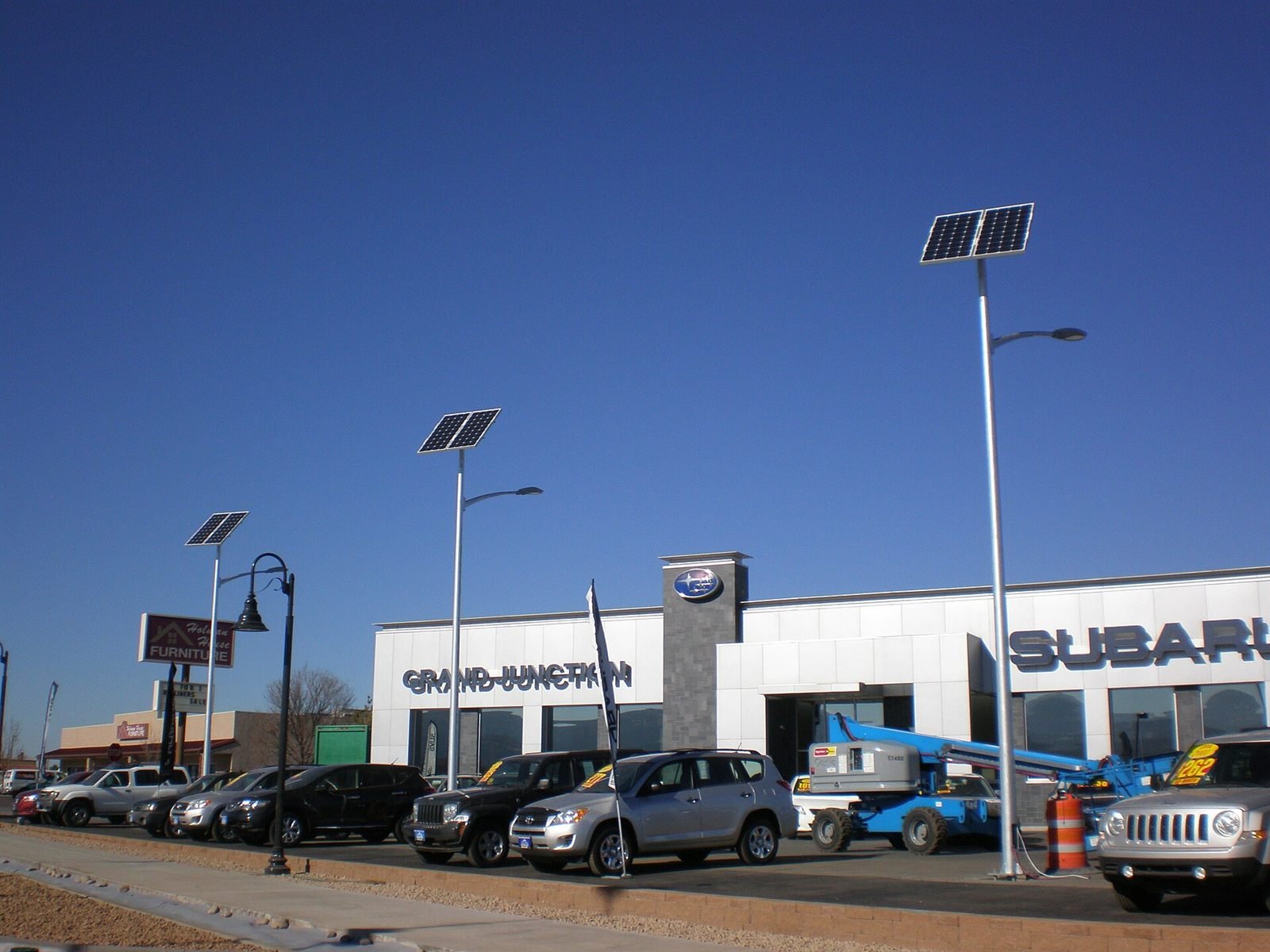
Cover photo: split-type solar street lights in a car park. Klau1983 / Wikimedia Commons, CC BY-SA 3.0.
The five at a glance
| Company | Base and production | Representative range | Battery chemistry | Best fit |
|---|---|---|---|---|
| ShineTong | China | ST-SSL-AIO, AIO-PRO, AI2, SPLIT, GARDEN, poles | LiFePO4, replaceable | Distributors and EPCs who want sizing, lights and poles in one quote |
| Signify | Netherlands, global | SunStay Pro, SunStay Pro gen2 | LiFePO4, replaceable | City projects that want a global brand and Interact City connectivity |
| Fonroche Lighting | Agen, France | Smartlight with Power 365 | NiMH | Municipal and national programmes needing year-round autonomy |
| Leadsun | Zhuhai, China, with Australian roots | AE3C, AE5, AE6, Freedom | LiFePO4 | Parks, pathways and car parks wanting compact integrated units |
| SEPCO | Stuart, Florida, USA | SolarViper and custom systems | Specified per project | US federal and municipal jobs with Buy America requirements |
The five manufacturers
1. ShineTong Solar Street Lights
ShineTong supplies solar street lights to distributors, EPC contractors and project buyers who need more than a single catalogue model. The range covers the three structures that matter in practice:
- All-in-one (ST-SSL-AIO and AIO-PRO): panel, LiFePO4 battery, MPPT controller and LED in one head, for residential streets, car parks and village roads at 4 to 8 m. The PRO version adds radar or PIR motion boost and remote configuration options.
- All-in-two (ST-SSL-AI2): separate tilt-adjustable panel, with battery and controller inside the lamp, for collector roads and industrial yards.
- Split type (ST-SSL-SPLIT): separate panel, head and battery box for main roads at 8 to 12 m, high latitudes and long autonomy targets.
- Garden lights and poles: 3 to 4 m pathway lights, plus hot-dip galvanized poles, arms and anchor cages from 3 to 12 m.
What makes ShineTong different is the order of work. We ask for the site location, the night profile and how many nights without sun the light has to run, and only then pick the panel and battery. The quotation states the battery watt-hours and panel watts, not just an LED wattage, so you can compare it line by line with any other offer. Batteries are replaceable, and spare packs can ship with the first order.
What we do not claim: we do not publish price lists, and we do not print certification badges on our pages. Certification documents differ by model and market, so each quotation states which test reports cover the exact model you are buying. Full details are on our solar street light page.
Planning a solar lighting project? Send us the site and we will size it.
2. Signify (Philips SunStay Pro)
Signify, the company behind Philips lighting, sells the SunStay Pro all-in-one solar street light. It is a well-documented product: the datasheets list an LFP battery, an MPPT controller, IP66 with IK08 or IK09 impact ratings depending on version, a radar motion sensor option and off-grid or hybrid charging. One SunStay Pro configuration, for example, pairs a 2,745 lm, 17 W LED with an 18 Ah, 25.6 V LFP battery rated for 2,000 cycles and a 65 W panel, with a five-year warranty.
The battery is replaceable, and the luminaire is "System Ready" for Signify's Interact City management platform, which matters to cities already running Philips street lighting. One detail worth noting: Signify's own documents say solar sizing should be done by Signify or a partner it has trained. In other words, even the biggest brand treats sizing as a project service, not a box you pick off a shelf.
3. Fonroche Lighting
Fonroche Lighting, founded in 2011 and based in Agen in south-west France, builds the Smartlight range around its own Power 365 energy system, which it says guarantees light 365 nights a year. Unlike most of the market, Fonroche uses nickel-metal hydride (NiMH) batteries rather than lithium iron phosphate, and argues they handle extreme heat and cold better and last 10 to 12 years.
The reference list is the strongest on this page. Fonroche reports more than 250,000 solar street lights installed, operations in over 50 countries, and national programmes in Senegal (around 120,000 lights) and Benin (a 2019 tender for over 15,000). Products are manufactured and assembled in France. For buyers outside Europe and Africa, check local service and lead times before you bid with them.
4. Leadsun
Leadsun was founded in 2005 and says it launched the first all-in-one solar street light in 2008, combining a slim panel, lithium battery and adaptive LED control in one unit at the top of the pole. Manufacturing is in Zhuhai, China, with design and testing roots in Australia, and the company reports more than 300,000 systems installed through offices and distribution partners on several continents.
The AE series covers most public-space jobs. The AE6, for instance, comes with a 150 W or 200 W panel, a 30 to 50 W or 50 to 80 W LED, and a 64 Ah (820 Wh) or 96 Ah (1,229 Wh) lithium battery, with a five-year warranty. Leadsun publishes battery watt-hours, which is exactly the number buyers should ask every supplier for.
5. SEPCO (Solar Electric Power Company)
SEPCO has built commercial solar lighting under its own name in Stuart, Florida since 1994, and says its founder, Steve Robbins, had patented a solar street light by 1992. Every system is designed, engineered and assembled in the United States, and SEPCO states that its systems meet both the Buy America Act and the Build America, Buy America Act, which is often a deciding factor for federally funded US projects.
SEPCO sizes each system for the local solar resource and the longest night of the year at the site, and offers pole designs rated to AASHTO wind loads, including hurricane-class ratings. It is a specialist choice for US public works, military and coastal projects rather than a volume supplier for export distributors.
Also worth a look
Several other names come up in tenders. Sunna Design (France) focuses on autonomous lights for hot climates with remote monitoring. Sol by Carmanah and Greenshine are established in North America. Sresky and SOKOYO are large Chinese manufacturers with wide integrated-light ranges. They did not make our top five because, for a typical distributor or EPC buyer, the five above cover the main buying routes more clearly. Each is still worth a quote on the right project.
Why the wattage on the box can mislead you
A solar street light's LED wattage tells you how bright it can be. It does not tell you how long it can stay that bright. That depends on the battery and the panel. A quick worked example shows the gap:
- A light run at 40 W for four hours, 20 W for four hours and 12 W for four hours uses about 288 Wh per night.
- Three nights of autonomy at 80% usable depth of discharge needs about 1,080 Wh of battery.
- In a winter month with 3.5 peak sun hours and about 75% system efficiency, the panel needs about 110 W just to break even, so a sensible design uses 130 to 150 W.
Now look at a "100 W" all-in-one light with a 30 Ah, 12.8 V battery. That is about 384 Wh in total, or a little over one night at the profile above once you keep a safe reserve in the battery. This is the most common reason solar street light projects fail, and it is why every serious manufacturer on this list sizes per site. Off-grid design guidelines from the World Bank's Lighting Global programme typically use 3 to 5 days of autonomy, and 7 or more where long cloudy or snowy spells are common.
How to compare solar street light suppliers
- Ask for battery watt-hours and panel watts in writing. Not just "LED 100 W". Divide battery Wh by your nightly energy to see the real number of nights.
- Size for the worst month, not the yearly average. December in the northern hemisphere and June in the southern can have half the sun of summer.
- Prefer LiFePO4, or NiMH for extreme temperatures. Note that LiFePO4 should not be charged below 0 °C without a heater or a controller that blocks cold charging.
- Check that the battery is replaceable. It is the first part to wear out. A sealed head means replacing the whole light.
- Match the lighting class. Ask for a lighting calculation against EN 13201 in Europe or IES RP-8 in North America, not just a lumen figure.
- Read the warranty by component. Many lights carry a long LED warranty but a much shorter battery warranty.
- Get certificate numbers for the exact model. A badge on a website is not a test report.
- Price the pole and foundation too. Wind load on the panel decides pole thickness and base design, and that can change the project cost more than the light itself.
The market in brief
Market estimates vary widely depending on what is counted. The Business Research Company puts the global solar street lighting market at about US$12 billion in 2025, while P&S Intelligence estimates about US$6 billion. Both agree that Asia-Pacific is the largest region, and that public tenders in Africa, South Asia and the Middle East are a major source of demand. For buyers, the practical point is that the market is fragmented: hundreds of factories sell lights that look identical, which makes sizing, documents and after-sales support more important than the product photo.
Related reading
Pairing street lights with other off-grid kit? See our guide to how solar panels are manufactured and the top 10 solar panel manufacturers in China. If you are building a full container of solar products, our sourcing service can combine lights, panels, cabling and energy storage in one shipment. Browse the full ShineTong solar street light range.
Get a sized quote for your solar street light project
Tell us the location, road type, pole spacing and how many nights without sun the lights must cover. We reply with panel, battery and pole details in writing.
Frequently asked questions
Who is the best solar street light manufacturer?
There is no single best one for every project. Signify and Fonroche Lighting have the deepest municipal references, Leadsun is strong on integrated all-in-one lights, SEPCO suits US projects with Buy America requirements, and ShineTong suits distributors and EPCs who want lights, poles and per-site sizing in one quotation.
Are all-in-one solar street lights better than split systems?
Not better, just suited to different jobs. All-in-one lights are faster to install and fit pathways, residential streets and car parks up to about 8 m. Split systems carry a larger panel and battery and allow the panel to be tilted for winter sun, so they suit main roads, high latitudes and long autonomy targets.
How long does a solar street light battery last?
LiFePO4 batteries are typically rated for around 2,000 cycles or more, and Fonroche quotes 10 to 12 years for its NiMH storage. Real life depends on heat, depth of discharge and sizing, so choose a design with a replaceable battery and budget for one replacement during the project life.
How many nights can a solar street light work without sun?
It depends on how the battery was sized. Off-grid guidelines typically use 3 to 5 nights, and 7 or more for very cloudy or snowy regions. Ask the supplier which autonomy their quote is based on, at which dimming profile.
Does ShineTong supply poles and OEM solar street lights?
Yes. ShineTong quotes hot-dip galvanized poles from 3 to 12 m, arms and anchor cages with the lights, and offers OEM logo, housing color and packaging for distributors. Send your project details through our inquiry form.
Sources
- Signify, SunStay Pro product family leaflet and datasheets: signify.com
- Philips SunStay Pro VGP725 product leaflet: lighting.philips.com
- Fonroche Lighting, reference guide to solar street lighting: fonrochesolarlighting.com
- Fonroche Lighting, company and Senegal / Benin projects: fonroche-lighting.com
- Fonroche Lighting America, Smartlight and installed base: fonrochesolarlighting.com
- Leadsun, company history and AE6 specifications: leadsun.com.au and leadsunglobal.com
- SEPCO, Made in America and solar street lighting: sepco-solarlighting.com
- Lighting Global (World Bank), quality assurance guidelines for off-grid solar systems: lightingglobal.org
- The Business Research Company, solar street lighting market report: thebusinessresearchcompany.com
- P&S Intelligence, solar street lighting market analysis: psmarketresearch.com
- Cover photo: Klau1983, Wikimedia Commons, licensed CC BY-SA 3.0
- ShineTong solar street light range: shinetong.com
